How the High Seas Became a Shared Space
The high seas became a shared space through centuries of maritime rivalry and legal argument; trace key milestones to understand why open passage matters.
The high seas became a shared space through centuries of rivalry and legal argument, not because distant oceans were empty. A useful history runs from Portugal and Spain’s competing claims in the fifteenth and sixteenth centuries to the modern law of the sea, while keeping trade, power, and access in view.
What did early ocean claims try to control?
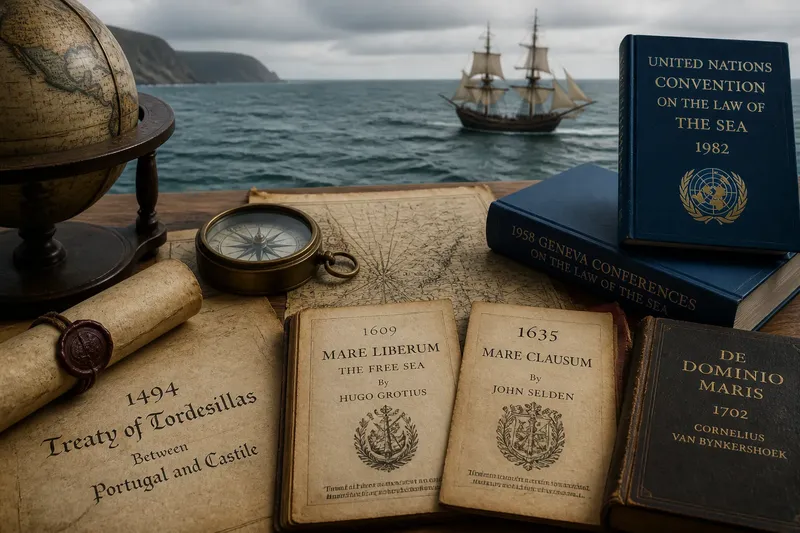
In the fifteenth century, Portugal and Castile sought papal backing for competing claims over overseas routes and territories. Pope Alexander VI’s 1493 bulls addressed those rival claims after Columbus’s first voyage, and the Treaty of Tordesillas in 1494 drew a dividing line for the two crowns’ spheres of expansion. It was an agreement between those parties, not a universal settlement accepted by other powers or the people whose lands and waters were affected.
The episode shows why a sea claim could matter even when a ruler could not govern every distant wave. Claims could support exclusive trade, frame diplomatic bargaining, and justify voyages. Other states and mariners did not automatically accept the boundary, so practice at sea continued to challenge lines asserted from Europe.
Why did Grotius argue for an open sea?
In 1609, Dutch jurist Hugo Grotius published Mare Liberum (The Free Sea). Written amid Dutch commercial conflict with Portugal in Asia, it argued that the sea could not be appropriated like land and that navigation and trade should remain open. The work made a case useful to Dutch interests; it was not a detached description of an uncontested rule.
England’s John Selden challenged that position in Mare Clausum, published in 1635, defending the possibility of maritime dominion. The disagreement makes the debate easier to follow: Grotius emphasized open navigation, while Selden supplied an argument for control. Neither book by itself settled what states could enforce or what other communities would recognize.
How did rival claims shape maritime practice?
European powers continued to assert authority over particular waters and routes while competing for trade and naval influence. In the eighteenth century, British jurist Cornelius van Bynkershoek’s De Dominio Maris (On the Dominion of the Sea), published in 1702, discussed maritime control in relation to a state’s capacity to defend it. The work became part of a broader debate about the reach of coastal authority, rather than a simple rule that ended disputes.
These arguments concerned more than abstract ownership. A state might seek to protect a harbor, restrict a rival’s access, or secure a route. The practical question was whether a claim could be maintained and recognized, not merely whether a ruler had announced it.
When did shared waters enter modern international law?
The twentieth century brought wider efforts to codify maritime rules. The United Nations held its first Conference on the Law of the Sea in Geneva in 1958, producing four conventions on subjects including the territorial sea, the high seas, fishing, and the continental shelf. The conference created treaty texts, but questions remained about the breadth of coastal zones and how to balance access with coastal rights.
The United Nations Convention on the Law of the Sea, adopted in 1982, set out a more comprehensive framework. It distinguishes areas under coastal-state jurisdiction from the high seas, where no state may claim sovereignty over the water itself. It also sets rules for navigation and other activities. “Shared” here does not mean that every use is unrestricted or that the ocean has no rules; it means that the high seas are not the exclusive territory of one state.
What does the history clarify about the high seas?
Did Grotius invent the idea of open seas?
No. Mariners crossed oceans and states pursued maritime interests long before 1609. Grotius gave a prominent legal argument for open navigation in a specific political and commercial dispute.
Does the high seas mean waters close to every coast?
No. Modern law distinguishes the high seas from maritime zones where coastal states have defined rights or jurisdiction. The precise status of an area depends on its location and the applicable law.
Does “shared” mean anyone can do anything there?
No. The high seas are not subject to one state’s sovereignty, but international rules govern activities there. Specific obligations and permitted uses depend on the activity and the relevant legal framework.
How can you follow the historical argument?
Use documents and events as concrete anchors rather than treating “open” and “claimed” as timeless labels. For each episode, note the claimant, the interest at stake, and who was left outside the agreement.
- Check the parties to the Treaty of Tordesillas; if you see only Portugal and Castile, treat it as a bilateral division, not a universal ocean settlement; if a source calls it universal, look for evidence of acceptance by other powers.
- Check the publication and context of Mare Liberum; if the Dutch-Portuguese dispute is identified, read its open-sea argument as both legal reasoning and an intervention in commercial rivalry; if context is missing, avoid presenting it as politically neutral.
- Check Selden’s Mare Clausum against Grotius’s earlier work; if the contrast is clear, describe a debate over dominion and navigation; if a source says one author conclusively won, verify that claim against later state practice and treaties.
- Check which subject a 1958 Geneva convention addresses; if it concerns the territorial sea, high seas, fishing, or continental shelf, name that subject precisely; if the source gives only “the law of the sea,” consult the treaty title before describing its scope.
- Check whether a modern passage refers to the high seas or a coastal maritime zone; if it means the high seas, discuss the absence of state sovereignty alongside applicable rules; if it means a coastal zone, identify the coastal state’s relevant rights instead.
- Check whose interests a source describes; if it records only European crowns or trading powers, state that limited perspective; if it includes affected coastal peoples and other states, explain how their positions alter the account.
Say you are reading a hypothetical classroom handout that says the Treaty of Tordesillas divided the oceans for the world. Start with the named parties: Portugal and Castile. Then compare that claim with Grotius’s 1609 argument, written in a Dutch-Portuguese commercial conflict, and with the United Nations conferences of 1958 and 1982. The resulting account should distinguish a bilateral imperial agreement, a contested argument for open navigation, and later international rules; the handout’s claim of universal agreement does not follow from those inputs.
The search phrase “history of the high seas as a shared space” points to a long argument, not a single founding moment. When a source calls the ocean open, ask which rule, period, and parties it means; that small check keeps a claim about access from being mistaken for a claim that the sea has no law.